

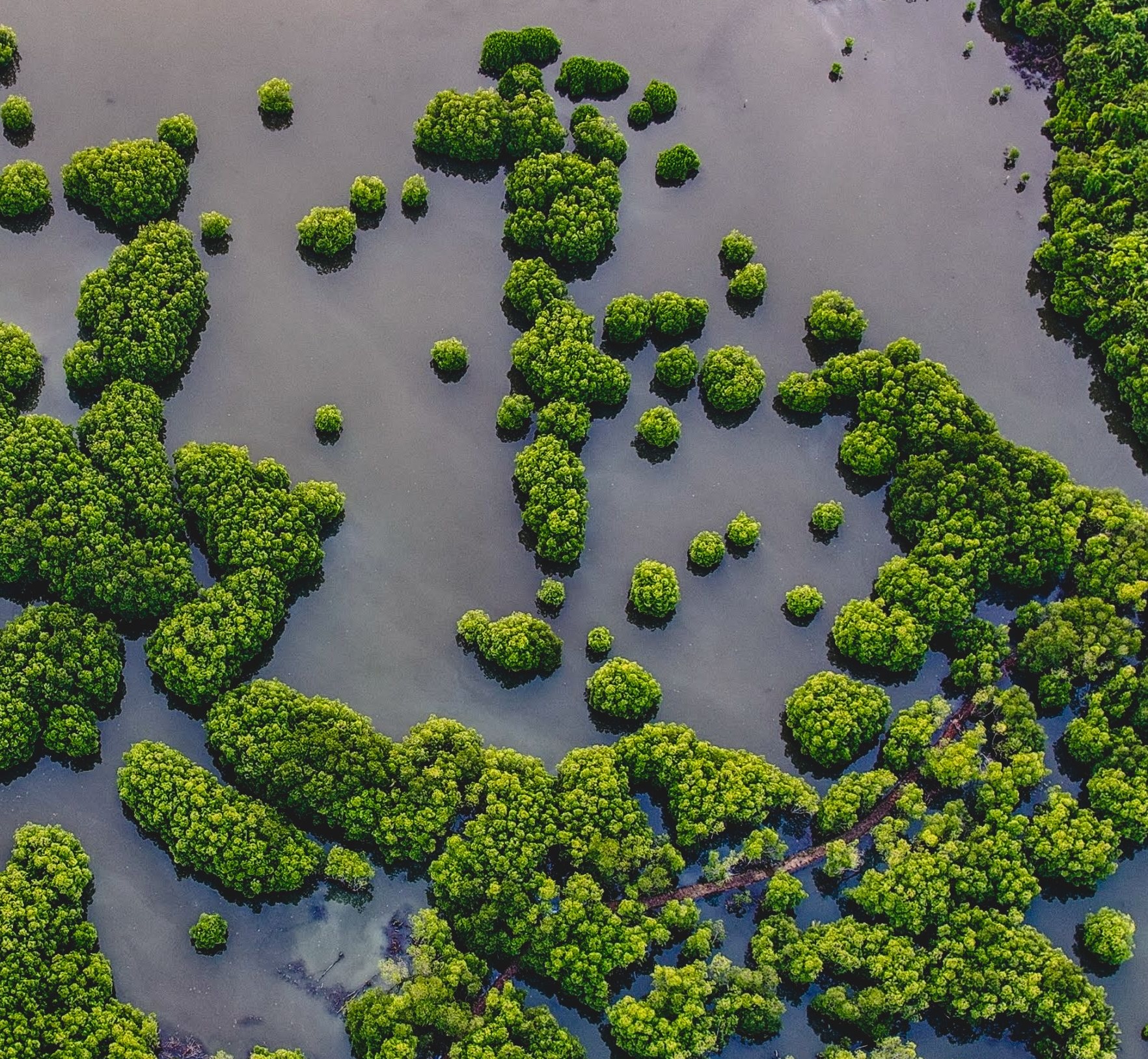
Photo: Theofilo Navaez (Pexel)
Indonesia holds roughly a quarter of the world’s mangrove forests and about 15 percent of its seagrass meadows, spread along one of the longest coastlines on Earth. National mapping puts the country’s mangrove cover at somewhere between 3.2 and 3.4 million hectares, depending on the year and method used. According to Daniel Murdiyarso, a principal scientist at the Center for International Forestry Research and World Agroforestry (CIFOR-ICRAF) and president of the Indonesian Academy of Sciences, those forests hold carbon reserves in the range of 3 billion tons. Conserving that stock, he has argued, would deliver climate benefits on the same scale as avoiding a meaningful share of the country’s fossil fuel emissions.
The reason blue carbon ecosystems punch above their weight comes down to where the carbon sits. Unlike a tropical forest, where much of the stored carbon is in trunks and canopy above ground, mangroves and seagrasses bury a large share of theirs in waterlogged soil below the surface. Low oxygen slows decomposition there, so carbon that would break down quickly on dry land can stay locked in coastal sediment for centuries. Per hectare, some researchers estimate coastal ecosystems sequester carbon up to ten times more efficiently than boreal, temperate, or tropical forests.
Conservation is the cheaper climate strategy
Public attention around blue carbon tends to gravitate toward restoration: planting mangroves back where they have been cut down. Murdiyarso has pushed back on that emphasis, pointing to the economics. A 2022 World Bank study estimated the average cost of restoring degraded mangroves in Indonesia at around USD 3,900 per hectare, and restoration projects fail often enough that the money doesn’t always convert into standing forest.
Protecting mangroves that already exist costs far less and, by some estimates, delivers a benefit-cost ratio roughly five times higher than restoration. That math has started to reshape how policymakers frame the problem: not simply “how much can we replant,” but “how much can we avoid losing in the first place.”
Losing it remains a real risk. Estimates suggest Indonesia could lose more than 26,000 hectares of mangrove a year to land conversion, driven mostly by aquaculture ponds, along with infrastructure development and illegal logging. Aquaculture alone accounts for close to half of historical mangrove loss nationally, with oil palm expansion a distant second. Shrimp farming in particular reshaped entire coastal regions during the late twentieth century, after a ban on destructive trawl fishing pushed many coastal communities toward pond-based aquaculture as an economic alternative.
A restoration target running into geography
In 2020, the Indonesian government set a target of rehabilitating 600,000 hectares of degraded mangroves by 2024, meant to match the total mangrove area the country had lost since 1990. Progress fell well short. By the end of 2024, the agency responsible for the program had rehabilitated an estimated 150,000 hectares, roughly a quarter of the goal.
Part of the shortfall turns out to be geographic rather than administrative. A nationwide suitability analysis led by Sigit Sasmito of the National University of Singapore and Mohammad Basyuni of the University of North Sumatra, published in Nature Ecology & Evolution, mapped every hectare of degraded mangrove against the physical conditions restoration actually needs: tidal flow, sediment type, land tenure, and twenty years of land-use history. The study found that only about 193,000 hectares nationally, roughly 30 percent of the government’s target area, meet the conditions for restoration to plausibly succeed. Planting mangroves on unsuitable ground rarely produces a lasting forest, whatever the hectare count on paper.
The finding reframes the restoration conversation without undermining it. Murdiyarso, who was involved in follow-up discussions with the restoration agency after the study’s publication, has described it as an opportunity to prioritize the limited suitable land more carefully rather than spread effort thin across sites unlikely to succeed.
Turning ecosystems into carbon credits
Indonesia has spent the past several years trying to build a market around its blue carbon assets. The government has signed mutual recognition agreements with international certification bodies, including Verra and Gold Standard, and opened its domestic carbon exchange to international buyers in 2025. Bilateral carbon-trading arrangements with Japan and Norway add another channel, though the Norway partnership was suspended briefly in 2021 over payment disputes before resuming the following year. The prices those credits command remain modest by international standards. Domestic carbon trading in Indonesia has averaged around USD 4 to 9 per ton, depending on the credit type, well below prices seen elsewhere. Murdiyarso has pointed to Japan’s seaweed carbon market, where prices have reached USD 400 per ton, as a benchmark for how undervalued Indonesia’s blue carbon currently is on the open market.
Officials involved in building the domestic market argue that credibility, not just price, is the binding constraint. Regulators overseeing the carbon exchange have noted that transaction volumes remain thin compared to equities markets, and that building investor trust will require a track record of verified, high-integrity projects rather than a handful of pilot sites. Researchers and civil society groups working on carbon governance echo that point, arguing that environmental integrity, meaning credible measurement and real emissions reductions rather than credits that exist mostly on paper, will determine whether international buyers take Indonesia’s blue carbon market seriously over the long run.
What gets left out of the carbon math
Framing mangroves purely as carbon infrastructure risks missing why coastal communities have depended on them for generations in the first place. Research led by Mulia Nurhasan, a scientist at CIFOR-ICRAF, has found that coastal households living near mangrove forests consume between 19 and 28 percent more fresh fish than households near converted or degraded coastal areas, a gap tied to the nursery habitat mangroves provide for fish and shrimp. Households near aquaculture ponds, by contrast, see only a marginal fish-consumption benefit, since ponds substitute one food source for a narrower, more commercial one.
Mangroves also offer income that doesn’t require a boat or heavy capital: fishing and gathering along the shoreline, accessible to community members, including women, who might not otherwise have an economic foothold in coastal fisheries. Researchers studying the sector argue that communities conserving mangrove forests, rather than converting them, are providing an ecosystem service and deserve some form of economic recognition for it, whether through carbon revenue, subsidy, or another mechanism, rather than being expected to conserve at their own expense.
Seagrass meadows raise a parallel question, with less public attention so far. Recent mapping work assessing seagrass ecological quality across dozens of Indonesian meadows found wide variation, from severely degraded sites to some of the healthiest meadows recorded in the region. That unevenness matters for blue carbon planning: a hectare of thriving seagrass sequesters carbon at a different rate than a degraded one, and protecting the healthiest remaining meadows may deliver more climate benefit per rupiah spent than trying to restore everything at once.
Bibliography
- CIFOR-ICRAF Forests News. Indonesia’s mangrove conservation could hold the key to blue carbon trading. https://forestsnews.cifor.org/94347/
- Mongabay. Indonesia’s mangrove restoration will run out of land well short of target, study warns. https://news.mongabay.com/2023/03/indonesias-mangrove-restoration-will-run-out-of-land-well-short-of-target-study/
- Mongabay. Indonesia’s mangrove revival hindered by conflicting policies. https://news.mongabay.com/2022/12/indonesias-mangrove-revival-hindered-by-conflicting-policies/
- Sasmito, S.D., Basyuni, M. et al. Challenges and opportunities for achieving Sustainable Development Goals through restoration of Indonesia’s mangroves. Nature Ecology & Evolution. https://www.nature.com/articles/s41559-022-01926-5
- World Bank. The Economics of Large-scale Mangrove Conservation and Restoration in Indonesia. https://thedocs.worldbank.org/en/doc/89fd7ff87561a4a913ed3371278e7933-0070062022/related/The-Economics-of-Large-scale-Mangrove-Conservation-and-Restoration-in-Indonesia-Brief-Note-Interactive-220516.pdf
- World Bank. Indonesia Sustainable Landscapes Management Program. https://www.worldbank.org/en/programs/indonesia-sustainable-landscapes-management-program/practice
- New Security Beat. A Tipping Point for Mangrove Restoration and Shrimp Farming in Indonesia. https://www.newsecuritybeat.org/2024/10/a-tipping-point-for-mangrove-restoration-and-shrimp-farming-in-indonesia/
- ChangeMakr Asia. Indonesia’s Mangrove Rehabilitation Plan Faces Hurdles Amid Bold Ambitions. https://changemakr.asia/indonesias-mangrove-rehabilitation-plan-faces-hurdles-amid-bold-ambitions/
- Nurhasan, M. et al. Mangrove forests support dietary diversity in Indonesian coastal communities. ScienceDirect / CIFOR-ICRAF. https://www.sciencedirect.com/science/article/pii/S2542519623001961
- Phys.org. Mapping Indonesian seagrass quality to target blue carbon conservation. https://phys.org/news/2026-08-indonesian-seagrass-quality-blue-carbon.html
- BIO Web of Conferences. Estimating Blue Carbon Stock: Mangrove and Seagrass Biomass Assessment in Tunda Island, Serang, Banten, Indonesia. https://www.bio-conferences.org/articles/bioconf/abs/2023/15/bioconf_macific2023_01009/bioconf_macific2023_01009.html
Comments are closed