

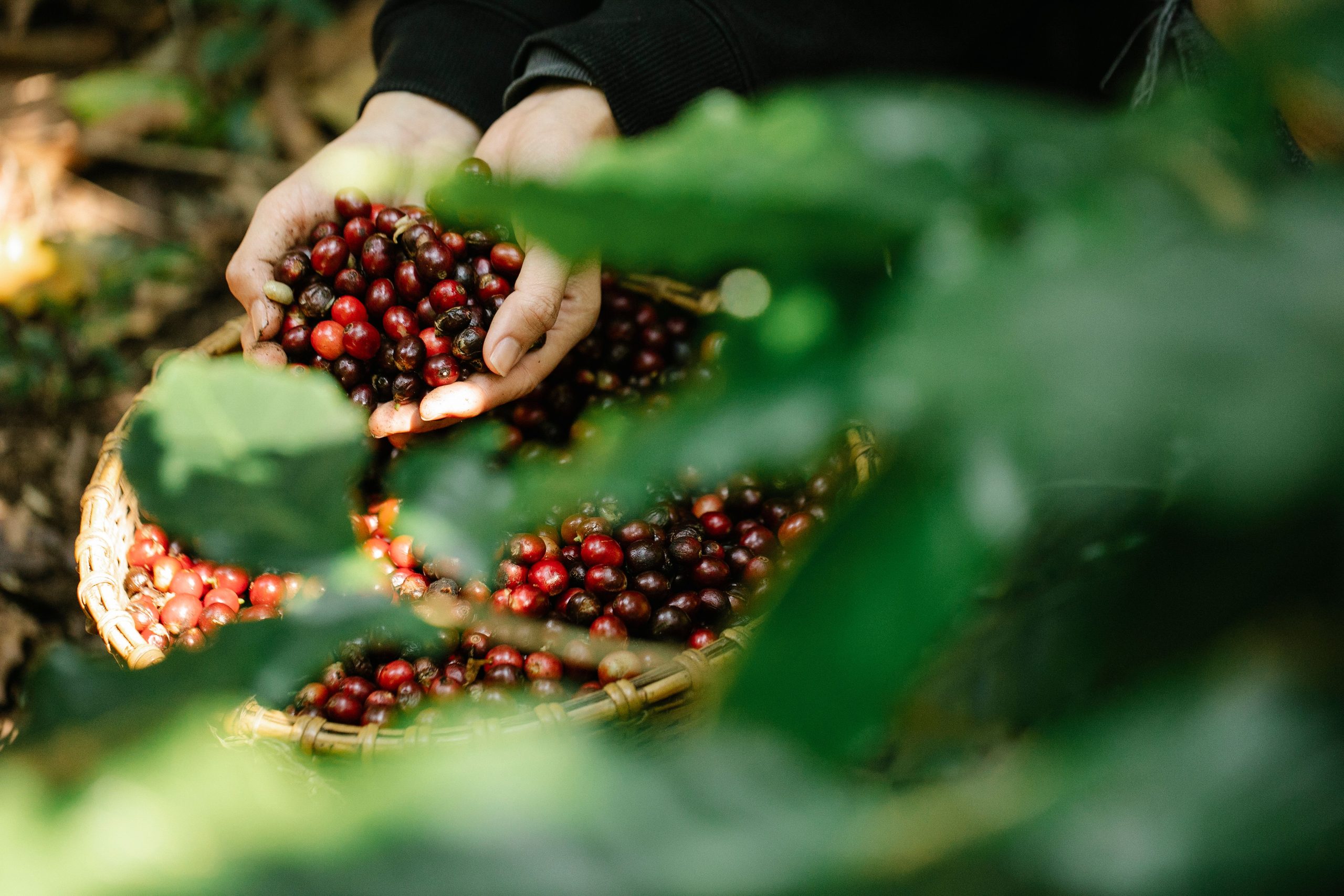
Coffee plantations climb nearly every slope around Lake Lut Tawar in Aceh Tengah, in Indonesia’s Gayo highlands. By 2024, coffee covered more than 49,000 hectares in the district, and the crop anchors the local economy. According to Bener Meriah’s district agriculture profile, 90 percent of people across the wider Gayo highlands, spanning Aceh Tengah and Bener Meriah, earn their living from arabica coffee.
Much of that coffee grows on land that overlaps with state forest. For years, that overlap left farmers as technically illegal occupants of gardens their families had worked for generations. Social forestry offers a way through that bind: legal standing to keep farming, on the condition that farmers keep the forest’s tree cover intact rather than clear it away.
KTH Mumuger, a farmers’ group in Aceh Tengah, is one of the groups testing what that arrangement looks like on the ground. Its members grow coffee in a multistrata system, layering it beneath several tiers of trees instead of open rows, in gardens that sit above 1,600 meters. A national research consortium singled the group out in 2025 for a closer look at how coffee and forest interact at that altitude.
The problem social forestry was built to solve
For decades, Indonesia’s forest law drew a hard line. State forest was state forest, and anyone farming inside it counted as an illegal encroacher, even families who had lived there for generations. That legal fiction didn’t stop people from clearing land for coffee, especially in mountainous regions where coffee is one of the few crops that grows well. It meant the farming happened with no incentive to do it sustainably. Farmers abandoned plots or expanded them haphazardly, forest cover thinned out, and conflict between communities and forest authorities became routine.
The Indonesian government built social forestry, or perhutanan sosial, to break that cycle. The scheme legalizes what communities were already doing on the ground and attaches rules to it. In exchange for formal, long-term access to manage state forest land, communities commit to keeping tree cover intact, staying out of core protected zones, and following sustainable land management plans. Indonesia’s Ministry of Environment and Forestry has allocated up to 12.7 million hectares nationally for this purpose, and by recent counts had granted formal titles covering close to 4.9 million hectares to roughly a million households, organized into thousands of local forest business groups.
Coffee, and arabica in particular, fits this model for a reason that has as much to do with plant biology as with policy.
Why arabica coffee likes living in a forest
Arabica coffee (Coffea arabica) is shade-tolerant. In full, unbroken sun, it stresses and produces less consistently. Under the canopy of taller trees, its yields and bean quality hold steadier, and the tree itself lives longer. That biological quirk makes arabica a convenient crop for agroforestry, farming systems that mix trees and crops on the same plot instead of clearing land for monoculture.
Researchers in West Java found the same pattern: farmers in social forestry programs gravitated toward coffee because it tolerated growing beneath the trees already standing on forest land, so they could earn an income without cutting down the canopy the law, and the ecosystem, required them to keep. Indonesian regulation built this logic into the permits themselves. Farmers can plant arabica seedlings among existing hardwood trees, using the forest’s own shade as infrastructure, without felling a single tree.
Aceh Tengah has an unusual head start here that researchers say goes underused. Large stretches of the district already carry pine plantations, the same species that shades some of Java’s most productive coffee agroforestry systems, yet few Gayo farmers have planted coffee beneath their existing pine stands. Elsewhere in Indonesia, that pairing is well established: in Petungkriyono, Central Java, farmers harvest what they call kopi umbaran, semi-wild coffee left to grow under the forest’s own big trees with no chemical inputs at all. On the island of Flores, farmers have grown Arabica Flores Bajawa coffee under forest canopy for generations, a shade-grown crop that now reaches buyers as far away as the United States and Europe.
What the forest gets back
Letting farmers keep growing coffee is only half the story. A research consortium led by Universitas Teuku Umar spent 2025 measuring what that coffee is doing to the forest around it, across three social forestry sites in Aceh, KTH Mumuger among them.
The numbers vary by altitude and species mix. A multispecies system in Aceh Jaya, combining coffee with jengkol, avocado, and areca palm, stored the most carbon of the three sites, 191 tons per hectare. KTH Mumuger’s coffee gardens, higher up and thinner on species diversity, stored less: about 59 tons per hectare, a difference the researchers attribute mainly to elevation above 1,600 meters. Despite the gap, one pattern held across all three sites: land under social forestry status stored more carbon than comparable agroforestry outside the program, or than land cultivated without conservation rules attached. The scheme appears to deliver both things it promises, forest carbon and coffee income, rather than trading one for the other.
A separate study in Desa Bah, Aceh Tengah, looked at household income rather than carbon. Farmers who integrated coffee into an agroforestry system alongside social forestry saw their income rise while forest cover held, the researchers found. The same study flagged the limits: farmers still lacked technical knowledge and struggled to reach markets, gaps that training and stronger institutions could close but hadn’t yet.
The gap between potential and reality
None of this is a fairy tale. Researchers studying the program are candid about its limits, and Aceh Tengah illustrates why.
The 2025 carbon study also measured social and economic vulnerability across its three sites, using a livelihood framework that scores access to education, finance, and institutional support. Aceh Tengah came out worst of the three: lower education levels among farmers, weak access to financial capital, and thin institutional capacity within farmer groups. Researchers marked KTH Mumuger as a priority for institutional support through 2026, precisely because its carbon performance outpaces its institutional readiness.
Market access remains a persistent weak point across Aceh’s coffee highlands more broadly. Farmers still sell mostly through middlemen, with little influence over the price they receive, and researchers studying Aceh’s arabica sector point to weak farmer institutions and inconsistent quality control as recurring obstacles to a better deal.
Environmental threats compound the institutional ones. Coffee farmers around Linge, in Aceh Tengah, have described watching a pest that once stayed below 800 meters climb to 1,200 meters in recent years, a shift they link to shrinking forest cover. Some of the same farmers have pushed back against a gold mining exploration permit covering land near their gardens, worried that mining activity nearby would degrade the forest their coffee depends on for cool, stable temperatures. Researchers flagged rising regional temperatures as a threat to Gayo coffee’s flavor profile years ago, and the concern has only sharpened as farmers watch both climate and land-use pressure build at once.
A specialty coffee with a conservation story
Despite the gaps, Gayo coffee already has what most social forestry coffee elsewhere in Indonesia is still working to build: global recognition. It carries a Geographic Indication certification, Starbucks has sold it under a Sumatra Gayo label, and it reaches buyers in the Netherlands, Germany, Japan, South Korea, and beyond. That recognition gives the social forestry pitch, coffee grown under forest cover by farmers with a legal stake in keeping that cover intact, a market already primed to listen.
The research consortium working in Aceh wants to turn that market position into direct payment for the forest side of the equation, not just the coffee. Win Fachruddin, of the Redelong Institute, argues that farmers who maintain agroforestry systems deserve more than moral recognition for the climate stability they help provide. He wants buyers to pay a premium tied specifically to that ecological contribution, a position that lines up with a 2026 forestry ministry regulation built around carbon incentives for community-managed forest. Elida Novita, who chairs the consortium, frames coffee agroforestry under social forestry as one of the most realistic low-carbon economic models available to Indonesia’s coffee farmers right now, not a distant ideal but something ready to scale.
Whether that materializes depends on the same institutions the vulnerability scores flagged as weak. Markets shift, certification takes years to secure, and forest conservation depends on whether farmers can build livelihoods stable enough that clearing more land stops looking like the easiest option. But in the Gayo highlands, where nine in ten people already depend on arabica and much of that arabica already grows inside state forest boundaries, social forestry is less an experiment than an attempt to catch up with a landscape people have been farming, encroachment and all, for generations.
Source
- The Conversation Indonesia. Kopi gayo mendorong pemulihan Aceh, tapi menyisakan persoalan lingkungan. https://theconversation.com/kopi-gayo-mendorong-pemulihan-aceh-tapi-menyisakan-persoalan-lingkungan-244946
- LintasGayo. 4 Universitas Perkuat Komitmen Agroforestri Kopi Berketahanan Iklim, Catat Stok Karbon hingga 221 Ton per Hektare di Aceh. https://lintasgayo.co/2026/04/18/4-universitas-perkuat-komitmen-agroforestri-kopi-berketahanan-iklim-catat-stok-karbon-hingga-221-ton-per-hektare-di-aceh/
- LintasGayo. Perhutanan Sosial: Jalan Legal dan Berkelanjutan bagi Perkebunan Kopi Rakyat Gayo di Aceh Tengah dan Bener Meriah. https://lintasgayo.co/2026/07/03/perhutanan-sosial-jalan-legal-dan-berkelanjutan-bagi-perkebunan-kopi-rakyat-gayo-di-aceh-tengah-dan-bener-meriah/
- Repong Damar: Jurnal Pengabdian Kehutanan dan Lingkungan. Penerapan Model Agroforestri Kopi Dalam Mendukung Perhutanan Sosial Di Desa Bah, Aceh Tengah. https://jurnal.fp.unila.ac.id/index.php/RDJ/article/view/11079
- Mongabay Indonesia. Petani Kopi Arabika Gayo Cemas Dampak Kehadiran Perusahaan Tambang Emas. https://www.mongabay.co.id/2024/10/23/petani-kopi-arabika-gayo-cemas-dampak-kehadiran-perusahaan-tambang-emas/
- Mongabay Indonesia. Petani Kopi Arabika Gayo Ungkap Kekhawatiran Dampak Perluasan Pertambangan Emas Linge. https://www.mongabay.co.id/2023/10/13/petani-kopi-arabika-gayo-ungkap-kekhawatiran-dampak-perluasan-pertambangan-emas-linge/
- Mongabay Indonesia. Pembabatan Hutan yang Mengancam Potensi Kopi Arabika Dataran Tinggi Gayo. https://mongabay.co.id/2015/06/24/pembabatan-hutan-yang-mengancam-potensi-kopi-arabika-dataran-tinggi-gayo/
- Alko.id. Perjalanan Kopi Gayo: Dari Perkebunan Rakyat hingga Pasar Dunia. https://alko.id/blog/perjalanan-kopi-gayo-dari-perkebunan-rakyat-hingga-pasar-dunia
- World Agroforestry (ICRAF). Coffee agroforestry tradition survives in Indonesia. https://www.worldagroforestry.org/news/coffee-agroforestry-tradition-survives-indonesia
- Rainforest Journalism Fund. Caring for the Forest With Coffee. https://rainforestjournalismfund.org/stories/caring-forest-coffee-bahasa-indonesia
- Perhutani. Perhutani Agroforestry, Bangun Desa Kopi di Hutan. https://www.perhutani.co.id/en/agroforestry-bangun-desa-kopi-di-hutan/
- Ministry of Environment and Forestry of Indonesia (KLHK/PPID). Kopi Petani Hutan Sosial Indonesia Mendunia. https://ppid.menlhk.go.id/berita/siaran-pers/6314/kopi-petani-hutan-sosial-indonesia-mendunia
- Forest Digest. Apa Itu Petani Hutan (Paradigma Baru Petani Hutan). https://www.forestdigest.com/detail/1552/apa-itu-petani-hutan
- Sanudin et al. (2024). Management of coffee agroforestry systems: lessons learned from a social forestry program in West Java, Indonesia. ResearchGate. https://www.researchgate.net/publication/379072906
- IOP Conference Series: Earth and Environmental Science (2021). Sustainable Arabica coffee development strategies in Aceh, Indonesia. https://iopscience.iop.org/article/10.1088/1755-1315/667/1/012106
Comments are closed